
.svg)


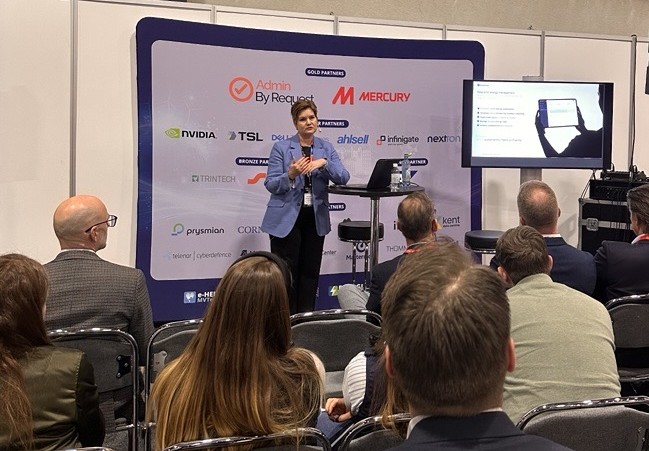
This article builds on insights I shared in a talk at Data Centre Expo Oslo 2026, where I outlined how power is becoming the defining constraint for data centre growth.
These insights are now strongly reinforced by ENSTO-E's recent report “From energy demand to grid support: data centre’s dual role”, which highlights the rapid growth in data centre electricity demand and their emerging role as active participants in the European power system.
Together, they point to a clear shift: the relationship between data centres and the power system is fundamentally changing.

For years, the main challenge in the data centre industry was compute. The focus was on scaling processing power, deploying infrastructure faster, and increasing computational capacity to meet growing digital demand. Over time, the industry became highly efficient at solving that problem. Compute became modular, scalable, and, given sufficient capital, deployable at speed.
Power, however, is fundamentally different. It cannot be scaled on demand. It is tied to geography, transmission infrastructure, permitting processes, and grid capacity. And unlike compute, it becomes increasingly constrained as more actors compete for access simultaneously.
This creates a new reality:
We have industrialised compute, but not access to power. As a result, the defining constraint is shifting. Not from growth itself, but from how growth is enabled.
Three structural forces are driving this shift across the Nordics and Europe.
AI workloads, cloud services, hyperscale expansion, and electrification are accelerating electricity demand at unprecedented speed.
ENTSO-E’s report highlights that data centres are becoming “systemically relevant electricity users” whose behaviour increasingly affects power system operation.
The challenge is no longer hypothetical. It is already visible in several European regions where data centre concentration is creating significant pressure on existing infrastructure.
The issue is not simply generation, it is delivery. Even regions with strong renewable generation can face severe connection constraints due to limited transmission and distribution capacity. Power availability no longer guarantees power access.
Projects are increasingly encountering:
· delayed grid connections,
· local congestion,
· and uncertainty around connection timelines.
For data centres, this changes the nature of site selection entirely.
The question is no longer:
“Is there renewable energy in this region?”
But rather:
“Can I access sufficient power, when I need it, within my project timeline?”
Electricity is no longer just a stable utility cost. Power markets are becoming increasingly dynamic, with growing intra-day volatility, balancing costs, congestion impacts, and shifting price signals.
For an industry where electricity represents a major share of operating expenditure, predictability matters as much as price. This changes the risk profile of data centre operations significantly.
The challenge is no longer only:
“How much does power cost?”
But increasingly:
“How certain are we about future access and pricing?”
These developments are not abstract energy market trends—they directly impact how data centres are designed, financed, and operated.
Historically, choosing a location was relatively straightforward:
· land,
· connectivity,
· cooling conditions,
· and available power.
Today, however, power availability does not necessarily translate into actual grid access. Projects can secure land and permits, yet still face connection delays of several years. This creates a new category of strategic risk for operators and investors alike.
Electricity already represents one of the largest cost drivers in data centre operations. But volatility and system complexity are making costs harder to predict and manage. Even facilities with long-term power agreements can face:
· balancing exposure,
· market variability,
· and increasing sensitivity to system conditions.
In this environment, energy becomes more than an operational expense, it becomes a core business risk.
Most data centres are designed as fixed, always-on loads. But the power system around them is becoming increasingly dynamic. Supply conditions fluctuate. Congestion shifts over time. Prices vary throughout the day.
This creates a growing mismatch between rigid consumption models and a flexible energy system.
As ENTSO-E highlights, data centres are no longer viewed solely as large consumers of electricity. Increasingly, they are also being considered potential providers of flexibility and grid support.
This marks an important shift in how the industry will evolve.
The most successful data centres of the future will not simply optimize for compute efficiency. They will optimize for how intelligently they interact with the power system around them.
That means:
· understanding when and how power is used,
· integrating flexibility into operations,
· and actively participating in electricity markets and grid services.
This is where the distinction between winners and losers begins to emerge.
· Treat power as a fixed input
· Plan for availability, not access
· Operate as rigid, always-on loads
· Treat power as a strategic variable
· Build flexibility into operations
· Adapt consumption to system conditions
· Engage actively with energy markets
The shift is clear: Power is no longer just a cost. It is becoming a competitive advantage.
This new operating model creates significant value, not only for the power system, but also for data centre operators themselves.
Potential benefits include:
· Reduced energy costs
· Improved resilience against market volatility
· Better access to constrained grids
· Increased integration of renewable energy
· Reduced need for costly grid investments
Even relatively small amounts of operational flexibility can create meaningful impact.
And importantly, this shift is no longer theoretical. It is already being explored and implemented through industry collaboration, research initiatives, and practical implementation projects across the Nordics and Europe.

At SnerpaPower, we work with grid operators, market platforms, research institutions, and industrial partners to develop software solutions that enable more intelligent interaction between energy-intensive operations and the power system.
Through initiatives such as the Net Zero Innovation Hub for Data Centres and other collaborative projects, we are exploring how data centres can operate more flexibly and efficiently within increasingly constrained energy systems.
What we are seeing is consistent:
· Flexibility creates immediate value
· Grid access is becoming dynamic
· Energy is becoming a strategic variable
The data centre industry is entering a fundamentally different operating environment.
Growth will no longer be defined solely by access to capital and compute.
Increasingly, it will be defined by access to power, and the ability to use it intelligently.
The key question is no longer simply:
Where can I build, and how fast can I scale?
But rather:
How intelligently can I operate within an energy system that is no longer stable?
The data centres that answer this question early will not only manage the constraints, they will turn them into advantage.
At Data Centre Expo Oslo, I framed this as a shift from power being an assumption to becoming a constraint, and ultimately, a competitive lever. What was clear from the discussions is that this shift is already underway. With ENTSO-E now reinforcing the same message at a system level, the direction is undeniable: the data centres that adapt early will not only manage the constraints but set the standard for how the next generation of digital infrastructure is built and operated.


.jpg)


.png)

.svg)


.png)